Welcome to Rejuvenation Science®!
 Questions? Please call us at
1-888-737-3588 TOLL FREE
Welcome to Rejuvenation Science®!
Questions? Please call us atOxygen is essential for life on earth. Without its presence, a human would not survive for more than a few minutes. Yet oxygen is a double-edged sword; as its existence gives life, so does it slowly take it away, by a process known as oxidation, the very process by which all things decay, and humans "return to dust". Almost every substance on earth is subject to attack and decay from oxygen. Gold is highly prized because it is essentially impervious to oxygen's attack, although its outer layer does eventually react with oxygen to form a visible brown or black coloration we call tarnish.
In humans, scientists believe that excess oxidative stress plays an important role in the initiation and promotion of atherosclerosis, cancer, cataract, arthritis and other degenerative diseases. Exposure to environmental perils, such as smoking, pollution or irradiation, eventually increases the oxidative stress beyond the ability of the organism's defense system to cope with it.
Free radicals are highly reactive forms of oxygen that damage cells throughout the body. As our body creates energy at the cellular level, oxygen is metabolized changing its structure. In this process, the oxygen molecule loses one electron, turning it into a free radical. Free radicals are inherently unstable since they contain “extra energy. To reduce their energy load, free radicals react with certain cells in the body, interfering with the cells’ ability to function normally. Free radicals also are created through detoxifying rancid fats and chemicals, such as drugs, food additives and preservatives; and by cigarette smoke, pollutants, sunlight, radiation, and emotional stress.
Just from oxygen consumption alone, an average 150 pound human utilizes about 3.5 mL oxygen/kg/minute, and if one assumed that about 1% of the oxygen is converted to the superoxide radical, about 1.72 kg or 3.8 pounds of deleterious superoxide radical would be produced per year. This does not take into account any of the multitude of other methods of producing, or other chemical forms of free radicals in the human body.
According to Richard Passwater, Ph.D., free radicals can result in approximately 80 different age-related diseases. These include cancer, heart attack, stroke, rheumatoid arthritis, cataracts, and Alzheimer's disease. The natural mechanism which protects us from free radicals weakens with age. Therefore, the elderly, smokers and those exposed to environmental hazards, are more susceptible to degenerative diseases. In today's high-stress "civilized" world, our harried lifestyle, combined with improper diet, over - consumption of fried, processed, and denatured foods, consumption of fats and oils which are themselves oxidized through improper storage and exposure to light and heat, all create damaging free radicals at an ever-earlier age. Exposure to sun, through the weakened ozone layer, also causes free radical destruction which appears as wrinkles, and brown or black spots, sometimes leading to cancers.
Standing as the major defender against harmful free radicals is glutathione, our body's own antioxidant, along with the liver - as the primary detoxifier of harmful chemicals both consumed and produced in the body. The livers antioxidant abilities are crucial to human life and well-being. An overburdened liver, with insufficient supply of antioxidants, will result in disease and even death.
There was a time, many decades ago, when a quieter lifestyle, coupled with better quality foods and consumption of more fresh vegetables and fruits, and better quality soil with more nutrients passed to our food supply, helped protect us from free radical damage. In this day and age, supplementation with antioxidants to fight free radicals and prevent age-related diseases is becoming a necessity rather than a choice. In fact, many doctors, including those who do not embrace nutritional supplementation, do take various antioxidant supplements to protect themselves, because they read the ever-increasing studies on their benefits. They believe that, at the very least, these substances are generally safe and can protect them from oxidative damage.
There are many types of antioxidants available. The most common ones are the vitamins C, E, A, and selenium. In the past decades, several important new forms of antioxidants have been discovered. Research shows that these antioxidants are many times more potent that the letter Vitamins, and also work in different ways for additional protection. Since numerous forms of free radicals are produced in the human body, it makes sense to supplement with a range of antioxidants which can deal with the different types of oxidative damage from all these radicals. Consuming these substances together at one time also adds another layer of protection from the "recycling effects" of their interaction among each other.
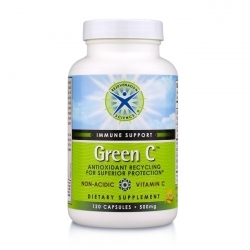
Green C™ contains those nutrients which, based on the latest research, have the highest level of antioxidant activity against a wide range of oxidative stressors. This highly researched new formula contains Vitamin C, an important form of an amino acid, N-acetylcysteine; a powerful liver protector, Alpha Lipoic Acid; and several plant extracts containing flavonoids and other plant antioxidants such as Grape Seed Extract.
Green C is a broad spectrum antioxidant formula, which effectively guards against many forms of free radical damage, thus protecting against a host of health problems and degenerative conditions.
What makes Green C™ so powerful and effective is the way its various components work as a team. They are not only powerful individually, but also function together in what is known as antioxidant cycling. Cycling extends the time that each one is functional in the body, and also strengthens each other's various functions. We now know that no one antioxidant is able to completely quench the various types of free radicals produced in the human body. It is necessary to take antioxidants together, each with specific and different benefits, to obtain the best protection, and to enhance each others' effectiveness.
For example, as the antioxidant vitamin E disables free radicals, it changes into a minor form of a free radical. Both vitamin C and alpha-lipoic acid convert this radical form of vitamin E back to its antioxidant-self. However, when vitamin C recycles vitamin E, it also changes to a free radical. Alpha-lipoic acid and glutathione can both "recycle" vitamin C back into a potent antioxidant.
Glutathione not only recycles vitamin C, but is the cells' primary antioxidant. Many scientists now state that maintaining high levels of glutathione is critical for a long and healthy life, as low glutathione levels are a marker for death at an early age. Glutathione diminishes as we age and cannot be boosted significantly by taking glutathione orally in supplements. The latest research shows that it is poorly absorbed in this form. This is why there is no glutathione in Green C.
Instead, Green C contains several powerful stimulators of the "glutathione pathway", to aid in production and protection of this vital endogenous substance. N-acetylcysteine is used by the body to manufacture glutathione, and alpha-lipoic acid regenerates glutathione, ensuring that the body has an adequate supply.
OPCs as found in Grape Seed extract play a role in cycling as they sacrifice themselves in order to neutralize harmful free radicals within the body: In doing so, they make it possible for vitamins C and E and selenium to do less "antioxidant" work, allowing these nutrients to perform their other functions in the body.
For example, victims of Parkinson's disease show low levels of glutathione in brain tissue. It's interesting to speculate that perhaps compounds that raise glutathione, such as lipoic acid, NAC, and the potent phenolics found in berries and their leaves, might be able to help prevent the development of Alzheimer's disease and Parkinson's disease, two of the most feared and disabling degenerative disorders of old age. All of these important substances are found, at useful levels, in a dally dose of two capsules of Green C.
The importance of Vitamin C as an antioxidant is well established in thousands of research studies. It is a cornerstone of conventional antioxidant supplementation. It is also synergistic with the other components of this formula.
Grape seed extract contains powerful antioxidants known as oligomers of proanthocyanidins (OPCs). Some studies say that OPCs are 20 times more powerful than vitamin C and 50 times more powerful than vitamin E. Grape seed is one traditional source of OPCs, although they are present throughout the plant world.
In a review of grape seed extract OPCs, Bombardelli and Morazzoni (Fitoterapia 66, no. 4 [1995]) state that OPCs' antioxidant effects are generally credited for their other benefits. The authors note that these include an antimutagenic effect (inhibition of the mutation of DNA). The authors point out that chronic degenerative diseases are believed to be a result of environmental mutagens (substances that cause mutation). OPCs may be able to counter these mutagens.
OPCs are like an "oral cosmetic". They protect collagen and elastin, an important part of the structure of skin, through their interlacing which gives skin its strength, elasticity, and smoothness. When these two substances are damaged by oxidation, the skin loses elasticity, and can form wrinkles. OPCs help restore damaged collagen and elastin and protect them against further damage.
Although still relatively little known, N-acetyl cysteine (NAC) is a powerful antioxidant and helps maintain immunity. It has been used since the 1960s as a mucolytic - a substance to break up mucus, especially in lung tissue - and has also been used for years in hospital emergency rooms to counteract acetaminophen poisoning. Clinical trials in Europe have indicated that NAC may also offer protection against the flu and flu-like symptoms.
NAC provides benefits because it helps 's increase the levels of one of the body’s most important and most powerful antioxidants: glutathione. The body itself produces glutathione to deal with the free radicals generated as part of our own metabolism. N-acetyl cysteine is used by the body to create more of this powerful and indispensable antioxidant. Research into NAC also indicates that it may enhance the production of human T-cells, an important part of the immune system.
Alpha lipoic acid is a "new" antioxidant that may turn out to be the most important of all antioxidants. First of all, it is the only antioxidant that is both water-soluble and fat-soluble, and can thus access all parts of cells which have both water-soluble and fat-soluble components. This unique quality enhances its ability to destroy free radicals throughout the entire cell. Alpha lipoic acid also works with other antioxidants to boost their levels. Taking alpha lipoic acid increases levels of vitamins C, E, glutathione, and coenzyme Q10.
Alpha-lipoic acid is especially powerful as an antiaging substance. Aging can be described as a process that reduces the number of healthy cells in the body. The major factors in reducing healthy cells are free radical damage and glycation. Glycation is the process in which protein in the body reacts with excess blood sugar (glucose), This damage is as detrimental to our health as that caused by free radicals. Alpha lipoic acid may keep blood sugar under control, which reduces glycation, and thus slows the aging process. Both free radicals and glycation affect the appearance of proteins found in the skin, so alpha lipoic acid is an anti-aging nutrient that can improve the quality of skin.
One bottle of Green C contains 60 capsules. Recommended dose is 2 capsules a day, one with morning and one with evening meals.
Recommended Products |
NEW PRODUCTS | |||
Superfoods Immune Energizer | |||
Recently Viewed |